










The Russian Tsvetnaya Bolonka: Understanding Correct Type
Click here to read the complete article
228 – May, 2026
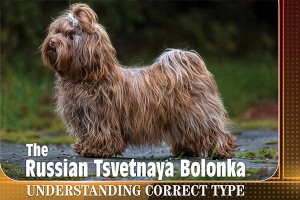 By Denise Dang, RTBCA Secretary “Breeder of Merit”
Co-Author – Tatiana Semenova-Petrossian, PhD Biology MSAOM “AKC Breeder of Merit”
“A toy breed may be small—but type is never small.”
The Russian Tsvetnaya Bolonka is proof of that.
The newest Russian toy breed recognized by the American Kennel Club arrives in the ring with charm, softness, and undeniable appeal. But beneath the curls and sweetness lies a history of survival, purpose, and resilience. To judge or breed this dog correctly, one must understand the forces that shaped it—and the type that preserves it.
This is not a fragile ornament. This is a sturdy; companionable dog built for real life.
Born From Hardship, Built for Purpose
In the years following World War II, Russia faced unimaginable devastation—more than 20 million lives lost, cities destroyed, and its dog population nearly erased. As families rebuilt living in small apartments and harsh climates, they needed a compact, hardy companion that could thrive in close quarters and cold weather while acting as an early alarm for the larger guard dogs.
By the early 1950s, the Leningrad Toy and Companion Dog section identified the “colored lapdog” as a distinct type. White dogs were excluded to stabilize color. A formal standard followed in 1966, and by the 1970s, roughly 100 dogs formed the foundation of the breed.
“The Bolonka was created to comfort people—but never to be delicate.”
Understanding this origin is essential. Correct type reflects a dog that is small, yes—but sturdy, capable, and resilient.
The Silhouette: Where Type Begins
Click here to read the complete article
228 – May, 2026

Short URL: https://caninechronicle.com/?p=357344
 Posted by AnthonyA
on May 21 2026. Filed under Current Articles, Featured.
You can follow any responses to this entry through the RSS 2.0.
Both comments and pings are currently closed.
Posted by AnthonyA
on May 21 2026. Filed under Current Articles, Featured.
You can follow any responses to this entry through the RSS 2.0.
Both comments and pings are currently closed.
Comments are closed