










The Peruvian Inca Orchid
Click here to read the complete article
86 – July, 2026
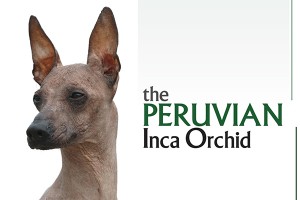 By Amy Fernandez
Who could have imagined it…a hairless breed competing in half of the AKC groups. We’ve had some time to reckon with the Chinese Crested in the Toy Group, the Xoloitzcuintli in Non-Sporting, and the American Hairless Terrier, well, take a guess. And now, the Hound Group will have its own hairless representative when the Peruvian Inca Orchid joins the crowd this coming December. And unfortunately, there’s no reason to anticipate any less confusion and misinformation this time around.
So, let’s focus on some genuine facts.
Like the Xolo, the recognition of the Peruvian is a belated acknowledgment of a breed that has existed for thousands of years. Based on archaeological evidence, the existence of hairless dogs in Peru dates to 300 BC. Although the name has linked the breed to Inca culture, hairless dogs were well-established throughout much of the region long before the rise of the Inca Empire.
In 1833, Darwin was the first naturalist to theorize that the hairless dogs of Peru were descended from the Xolos of Mexico. And it’s true that the Xolo was a deep-rooted theme of Mexican art for centuries, before similar motifs began to appear in Peruvian and Ecuadorian art. By the 1990s, anthropologists and archeologists had provided abundant evidence of the thriving civilizations and vigorous trade networks that existed between pre-Columbian and Mesoamerican societies thousands of years ago. Peru’s Supra Valley became the locus of some of the early population concentrations of the western hemisphere. In terms of size and sophistication, it rivaled anything in ancient Egypt during the same period. It became a major trading hub that stretched from modern-day California to the Amazon Basin. These trade routes not only shuttled textiles, jewelry, pottery, and other goods, but they also facilitated canine genetic exchange between cultures throughout the continent.
Click here to read the complete article
86 – July, 2026

Short URL: https://caninechronicle.com/?p=363282
 Posted by AnthonyA
on Jul 10 2026. Filed under Current Articles, Featured.
You can follow any responses to this entry through the RSS 2.0.
Both comments and pings are currently closed.
Posted by AnthonyA
on Jul 10 2026. Filed under Current Articles, Featured.
You can follow any responses to this entry through the RSS 2.0.
Both comments and pings are currently closed.
Comments are closed