










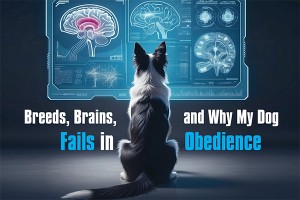
Breeds, Brains, And Why My Dog Fails In Obedience
Click here to read the complete article
170 – October, 2025
 By Caroline Coile
There’s not one of us who hasn’t stared into their dog’s eyes and wondered, “What the heck are you thinking?” Or if you’re like me, it’s more like, “What is wrong with your brain?”
Until recently, we had few answers to those questions. We had basic brain anatomy, usually taken from Beagles and occasionally, Greyhounds. But domestic animals were considered unworthy of behavioral studies, and dogs in particular were too variable to study. Besides, who wants to cut open a dog’s brain?
Stockard and the Early Days
There were exceptions. About a century ago, noted anatomist and eugenics follower Charles R. Stockard pioneered dog brain and behavior genetic studies with extensive crossbreeding experiments at Cornell University between 1927 and 1939. Stockard believed that different breeds’ morphology and behavior were the result of differences in their hormone levels from various endocrine glands, and he further believed that this same relationship could explain human behavioral and structural differences.
Stockard crossed breeds that exemplified extreme traits: Basset Hound, German Shepherd, Pekingese, Saluki, Dachshund, Bulldog, Boston Terrier, American Foxhound, Great Dane, Pomeranian, Brussels Griffon, French Bulldog, and Saint Bernard.
He tested them for behavioral differences, then made crosses between those with opposing physical or behavioral traits, then tested the offspring, then dissected them all with special attention to the glands–especially the thyroid and pituitary–as well as the brain.
Click here to read the complete article
170 – October, 2025

Short URL: https://caninechronicle.com/?p=340698
 Posted by AnthonyA
on Oct 18 2025. Filed under Current Articles, Featured.
You can follow any responses to this entry through the RSS 2.0.
Both comments and pings are currently closed.
Posted by AnthonyA
on Oct 18 2025. Filed under Current Articles, Featured.
You can follow any responses to this entry through the RSS 2.0.
Both comments and pings are currently closed.
Comments are closed