








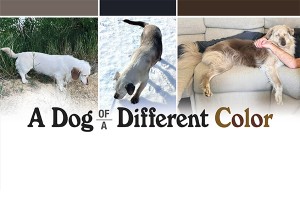
A Dog Of A Different Color
Click here to read the complete article
180 – April, 2026
 By Caroline Coile
In many species, odd colors are welcomed to the point that sometimes entire breeds are created around them. But in dogs, we tend to be conservative, especially when a color is related to possible health problems. We like our merle dogs to remain in our merle breeds, and our standards disallow the results of merle to merle breedings. They certainly disallow merles in non-merle breeds, silvers in non-silver breeds, and albinos in every breed. That said, the pet market has a demand for off-color dogs in every popular breed. Could the next fad “rarity” be colorpoints?
And how do these relate to albinos and Burmese-like patterned dogs?
Albinism and colorpoints are well-known in many mammals. In most of them, both traits appear to be caused by recessive alleles on the C locus. But that does not appear to be the case with dogs. In dogs, colorpoint is still caused by a recessive mutation at the C locus, but albinism is not.
What does seem to be shared throughout species with these coat patterns is some kind of mutation that affects the production of the tyrosinase enzyme that produces melanin. But the mutation need not be on the C-locus, as we shall see is the case in dogs.
Albino Dogs
Click here to read the complete article
180 – April, 2026
Short URL: https://caninechronicle.com/?p=354581
 Posted by AnthonyA
on Apr 15 2026. Filed under Current Articles, Featured.
You can follow any responses to this entry through the RSS 2.0.
Both comments and pings are currently closed.
Posted by AnthonyA
on Apr 15 2026. Filed under Current Articles, Featured.
You can follow any responses to this entry through the RSS 2.0.
Both comments and pings are currently closed.
Comments are closed