









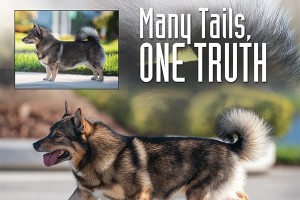
Many Tails, One Truth
Click here to read the complete article
178 – May, 2026
 By Robin Kelly
The Västgötaspets is an ancient breed of Sweden, known internationally as the Swedish Vallhund. Originating in the region of Västergötland, this primitive spitz herding breed is valued for its intelligence, versatility, and strong working character. Historical records trace the breed back to at least the 8th century, though it nearly disappeared in the 1940s before being revived through careful breeding efforts. One of the breed’s most distinctive traits is its naturally occurring tail variation. Swedish Vallhunds may be born with multiple tail types ranging from spitz, sickle, stub, and tailless. All tail types are accepted under both AKC and FCI breed standards, with no preference given to any particular type. Over time, tail type has become the subject of growing discussion, particularly regarding breeding practices and their potential impact on litter size, and possible links to spinal health. This article reviews peer-reviewed scientific literature and available breed-specific data to clarify what is known, what is often misunderstood, and what the research tells us about tail genetics and health in the Swedish Vallhund.
Within the breed community, questions have emerged about whether breeding certain tail types together, especially short-tailed or tailless dogs, could increase health risks. Concerns often focus on two primary areas:
1. Whether breeding short-tailed dogs together leads to smaller litters
2. Whether short tails are associated with spinal defects
Click here to read the complete article
178 – May, 2026
Short URL: https://caninechronicle.com/?p=357325
 Posted by AnthonyA
on May 17 2026. Filed under Current Articles, Featured.
You can follow any responses to this entry through the RSS 2.0.
Both comments and pings are currently closed.
Posted by AnthonyA
on May 17 2026. Filed under Current Articles, Featured.
You can follow any responses to this entry through the RSS 2.0.
Both comments and pings are currently closed.
Comments are closed