










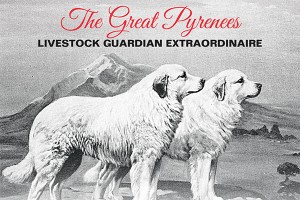
The Great Pyrenees – Livestock Guardian Extraordinaire
Click here to read the complete article
316 – February, 2026
 By Amy Fernandez
English ivy is the worst. It strangles every bit of plant life, destroys fencing and brickwork, and worst of all, it is impossible to eradicate. As the president of the local Audubon Society explained, “It’s hard to manage invasive species like English Ivy, but it’s even harder when those plants are on an island, and your organization doesn’t own a boat.” That was the situation on Maclellan Island, a nineteen-acre wildlife sanctuary in the middle of the Tennessee River. A range of invasive plant life was overrunning the island’s protected flora. After a “controlled burn” failed to resolve the problem, the local fire chief suggested a truly old school solution. Goats. No one had previously considered this remedy, but they were desperate. So, they took the advice and ordered six goats. But goats need 24/7 tending, and Maclellan is uninhabited. You know where this is going.
Livestock protection ranks among the earliest drivers of canine domestication. This essential canine job sparked multiple domestication events and clearly played a major role in mankind’s survival. Although countless livestock guardian breeds have disappeared, plenty of them continue to quietly and efficiently do their job all over the world.
?So, back to Maclellan Island. The Chattanooga Audubon Society’s rented goat herd came with an add-on in the form of Beo, a Great Pyrenees. Today, the Pyr ranks among the most widely used livestock guardian breeds, but for more than a century, its survival was a dicey prospect.
Click here to read the complete article
316 – February, 2026
Short URL: https://caninechronicle.com/?p=348875
 Posted by AnthonyA
on Feb 15 2026. Filed under Current Articles, Featured.
You can follow any responses to this entry through the RSS 2.0.
Both comments and pings are currently closed.
Posted by AnthonyA
on Feb 15 2026. Filed under Current Articles, Featured.
You can follow any responses to this entry through the RSS 2.0.
Both comments and pings are currently closed.
Comments are closed