










The Canine Singalong is More Than a Habit
By Amy Fernandez
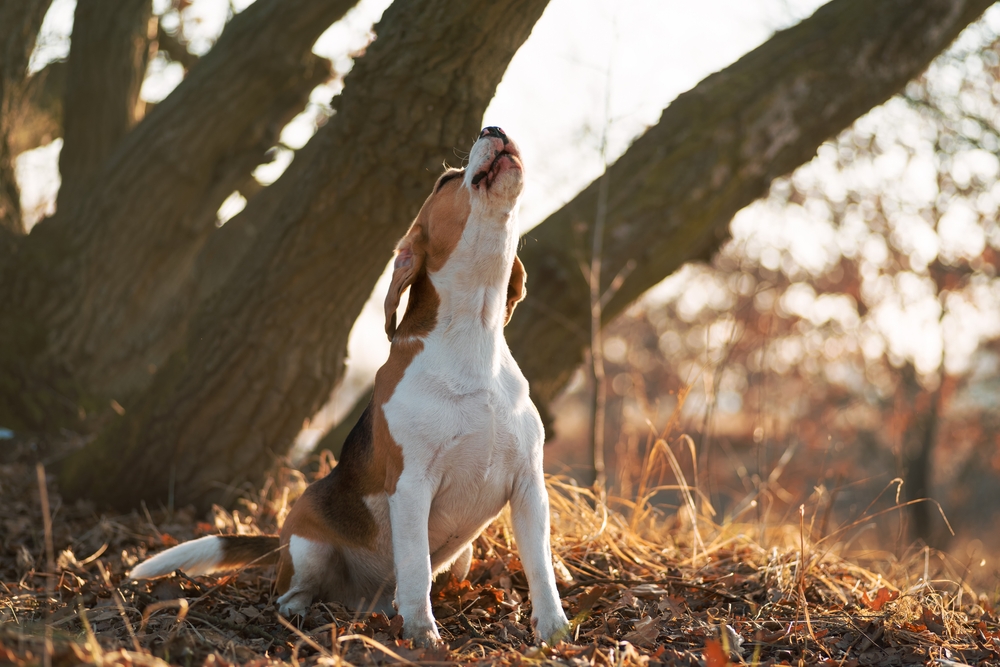 Those who don’t live with it non-stop tend to consider canine howling as charming, fascinating, etc. Those of us who do live with it usually have a different view. It’s piercing, unrelenting, unstoppable–and it gets attention. Of course, that’s precisely the point.
Howling is endemic to some breeds, but it’s also contagious. Bring a different breed into the mix, and they pick up the habit immediately. Here’s the thing: It may sound like chaotic noise, but howling is not mindless. This eerie vocalization style is quite nuanced, and it serves a purpose.
Now there’s some new research on the evolutionary aspects of this trait. The wolf/dog link to this behavior is well-established, but it may also have a link to the earliest evolution of human speech. That thought resulted in this fascinating study out of Tufts.
Psychologist Aniruddh Patel, who led the study, theorized that early humans may have utilized this same adaptive behavior strategy. From an evolutionary standpoint, this is a valid possibility. Unlike other domestic animals, human and canine evolution and survival strategies have been interwoven for eons. The earliest evidence of canine domestication long predated any signs of domestication in other species. Dogs diverged from their wolf ancestors between 30,000 to 40,000 years ago. The earliest evidence of sheep and goat domestication occurred a mere 11,000 years ago.
That suggests that at least some of our innate behavior patterns may be shared. Patel explained, “Howling has some similarities to human singing, in that these are long, sustained vocalizations…”. There has not been much research on dog howling, but wolf habits and behavior are well-documented.
It has been noted that packs tend to howl in different tones, and that’s not because they can’t carry a tune. This is intentional and coordinated. It’s meant to amplify their collective noise and overstate actual pack size. The intimidation value of that illusion is obvious. But they just as easily synchronize their pitch to produce that endless group sing-along we know so well. In wolves, that coordinated howling is meant to reunite the pack and reinforce group identity. In dogs, it also manifests in their tendency to sing along with people.
It may sometimes sound like a deafening car alarm, but dogs can and do finetune their howling to specific situations. Of course, humans also love singing–tuneful, off key, totally forgot the words–it doesn’t matter. Singing is infectious. It’s been documented in every human social group throughout history. But why, and more perplexing, how did it evolve? That led the Tufts team to theorize that human speech may have begun as part of the same adaptive strategy. The social functions of howling may have inspired the earliest attempts at intentional human vocalization. And hey, maybe we picked it up from our canine counterparts.

Short URL: https://caninechronicle.com/?p=354429
 Posted by Liz
on Apr 2 2026. Filed under Current Articles, Featured.
You can follow any responses to this entry through the RSS 2.0.
Both comments and pings are currently closed.
Posted by Liz
on Apr 2 2026. Filed under Current Articles, Featured.
You can follow any responses to this entry through the RSS 2.0.
Both comments and pings are currently closed.
Comments are closed