









The Calm Advantage: Why Regulation Creates Better Movement and Better Performance
Dr. Jillian Johnson
 In the performance dog world, we often focus on what we can measure — conditioning activities, training hours, skill progression, and competition results. But the most consistent dogs over time tend to share something less obvious: they’re regulated. Not dull or low-energy, but able to shift between effort and relaxation without living in brace.
When a dog’s nervous system is stuck in high alert, the body adapts. Specific muscles and organs are prioritized. Breathing becomes shallow. The spine stiffens. Stride shortens. Transitions between gaits or tasks require more effort, and fluid movement becomes harder to access — not because of attitude, but because the nervous system is prioritizing protection over performance.
Regulation gives the body the ability to process stimulation without bracing, release tension instead of storing it, and recover fully between efforts. That’s where true athleticism comes from: movement that looks efficient, responsive, and easy.
Dogs don’t perform in isolation. They are deeply influenced by their environment and their handler. Busy show schedules, travel, adrenaline, and pressure affect people too — and dogs are incredibly perceptive. A braced or stressed handler can unknowingly influence timing, leash tension, posture, and overall energy, which a sensitive dog may mirror through tighter movement or increased reactivity.
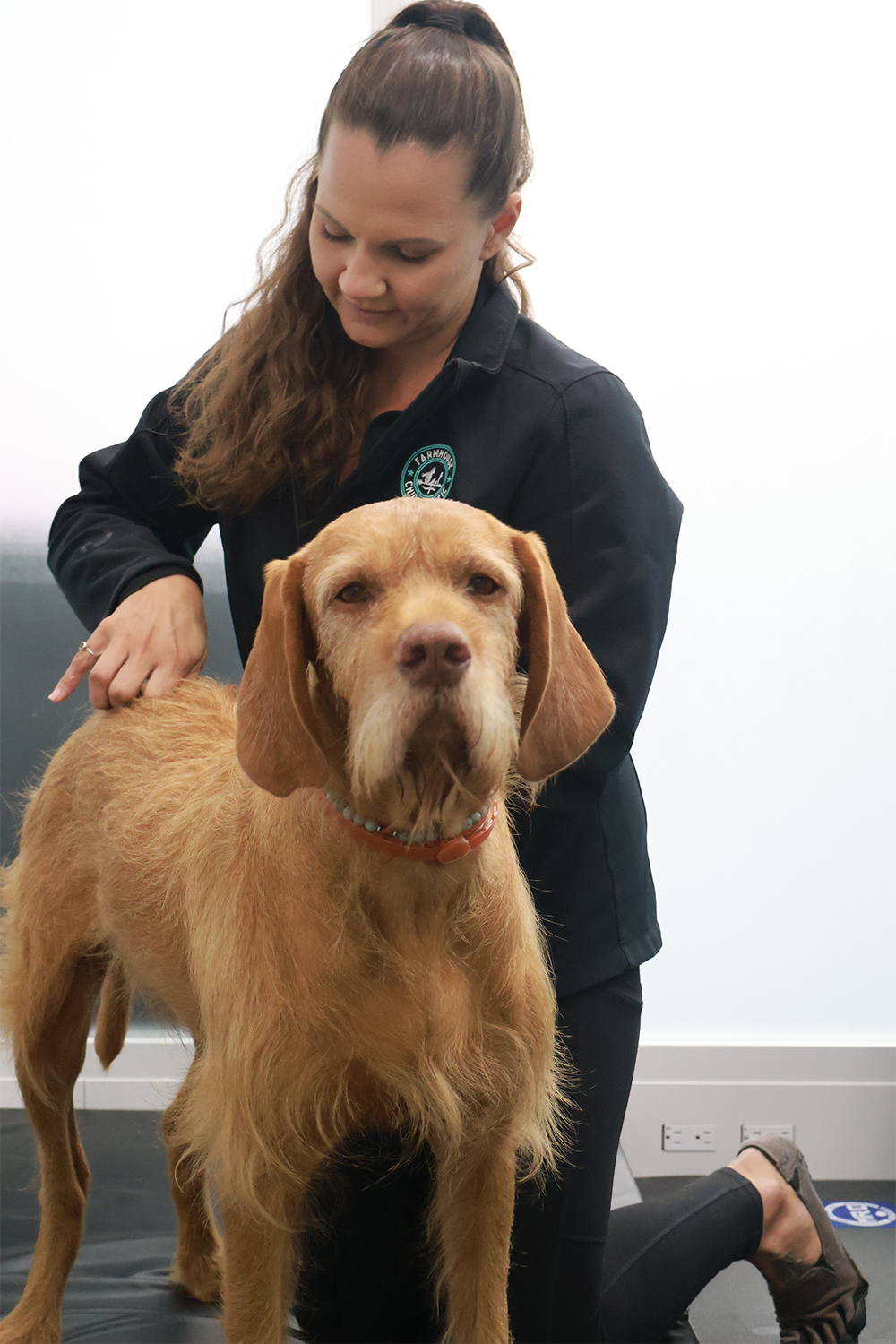
At Farmhouse, we view chiropractic care as nervous system care. The nervous system coordinates movement, recovery, and adaptability. When motion is restricted or stress is high, the body creates protective tension that can quietly interfere with performance. Our goal is to decrease that interference so the dog can access more ease, expression, and longevity. Because performance is a partnership, we also support handlers — helping both sides of the team move and function with greater regulation.
What the best programs prioritize (The Farmhouse Standard)
The most successful canine programs build regulation into the routine. They protect recovery, vary training intensity, and value softness and responsiveness as performance markers — not just speed or precision. They address small restrictions early, before compensation patterns become setbacks.
Regulation isn’t about lowering drive — it’s about refining it. A well-regulated dog can turn effort on and off, stay mentally available, and recover more efficiently between demands. In the long game of sport, that adaptability is one of the clearest markers of durability.
Short URL: https://caninechronicle.com/?p=351057
 Posted by Liz
on Feb 21 2026. Filed under Current Articles, Featured.
You can follow any responses to this entry through the RSS 2.0.
Both comments and pings are currently closed.
Posted by Liz
on Feb 21 2026. Filed under Current Articles, Featured.
You can follow any responses to this entry through the RSS 2.0.
Both comments and pings are currently closed.
Comments are closed