








Don Sturz Discusses Judging and the Continued Learning Process
By Amy Fernandez
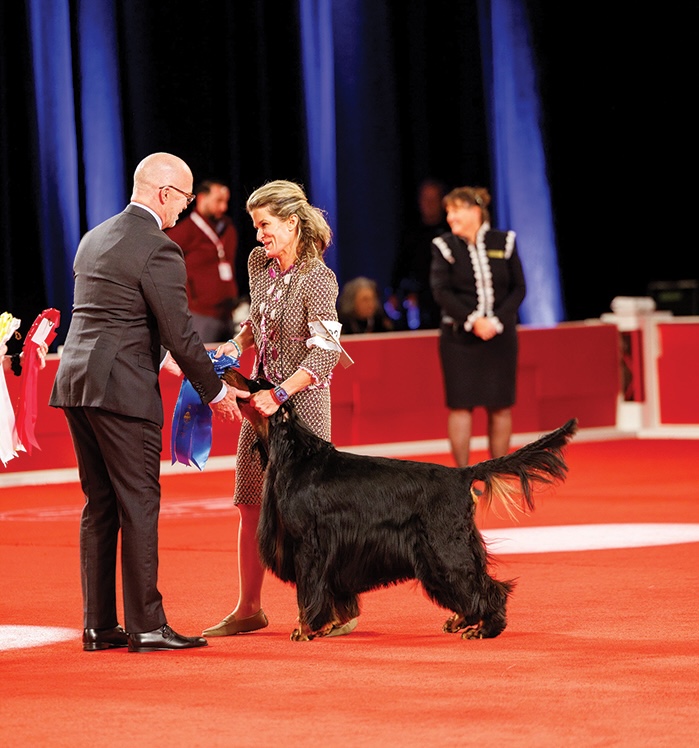
Photo by Congleton Photography
 There’s an undeniable mystique surrounding the judging profession–Supreme Court, figure skating and, yes indeed, this game. At any level, the impact attached to a single opinion is bound to invite questions–to put it mildly. Transparency is the obvious remedy, which is why major court decisions include pages and pages of legal reasoning. In our sport, it’s different. Explanations are not required. On the other hand, trust is the cornerstone of purebred philosophy. You get the point.
Let’s hear from a judge who is willing to explain. Dr. Don Sturz judged the Sporting group at the recent AKC National Championship in Orlando. But that’s not all he judged there. On Saturday, he also judged several Hound breeds. “I had beautiful, huge ring, which was perfect for breeds like Borzoi, Irish Wolfhounds and Greyhounds. It was the best way to see them, especially to see outlines and side gait, and for me that was a treat.” He notes that although this is a dog show, fitness for purpose always remains the baseline for evaluation– and these are coursing hounds.
He says, “During the day I was so honored with the Cirneco dell’Etna entry. I had 33 of them, and it was an amazing opportunity, super cool.” That’s an impressive entry for a typically low entry breed, but it’s not the main point. “I think that the rate of admission of new breeds can do a disservice when the judging community has not had sufficient opportunity to prepare to assess the breed in the way it deserves to be judged. One could argue they’ve been in the Miscellaneous Class, but it is not the same.” (Anyone who has done time showing a new breed in Miscellaneous can attest to the reality of that educational experience.)
He continues by saying, “Once a breed enters a particular group and greater numbers of them appear in the ring, it becomes a greater challenge. In my opinion, judges need to take that seriously, and make the effort to learn these new breeds.” AKC tries but the responsibility for judges’ education falls primarily on the designated parent club and their ability to organize Miscellaneous participation, provide comprehensive educational materials, and provide expert seminars. That often comes down to financial resources. That’s variable. What’s not variable is the inevitability of judging decisions that will overwhelmingly impact the breed’s direction.
“I have had many experiences judging a breed new to me, or new to the sport. I approach these situations knowing that I am far from an expert. After judging, I appreciate having conversations with the breeders, exhibitors, fellow judges, and field reps. It gives me an opportunity to not only get confirmation that I’m in the ballpark, but also to clarify where I might need to adjust my focus or prioritize. I think judges should be comfortable enough and humble enough to admit that they are learning from this. I am coming at this with the preparation and study I have been able to access on a new breed, as well as my foundation of general dog knowledge, and that of other similar breeds. You can read and study pictures until the cows come home, but when you are faced with evaluating and sorting live dogs in your ring it becomes another phase of learning. To me, it is an opportunity. I learn something every time I judge, sometimes even in breeds I have judged for decades.
“I look at things constantly from the perspective of reflection, what I prioritized that day, and acknowledge that I might have put too much emphasis on one trait and faulted when I should have stepped back and considered the whole picture of that dog. I learned this from Michelle Billings, who is obviously an iconic name in the sport. One afternoon we were at an airport waiting for our flight after a show, and we started talking about our weekend. She said she was thinking about what she had done in English Setters that day, and maybe she should have flipped her decisions on Best of Breed. She then proceeded to explain her reasoning for that comment, and that was such a teaching moment for me as a young judge. To hear this idol of mine conceding that it is okay to reflect and admit that maybe she should have done something differently. And her reason was exactly what I just referred to, she kind of got hung up on a particular trait in one dog and could not get past it. We are human and it is critical to have the humility to reflect on that. It’s not that you must do a public mea culpa and tell the world, but perhaps you want to think about it differently and be more mindful of taking the gestalt rather than getting stuck on a single feature of a dog.” That level of honesty from a judge is reassuring–but he has more to say.
“You make your decisions and hope others can understand what you did. I love oral critiques. It’s not for everyone, but as a concept–and I wish we had that option more often. I have done them at a few specialties, and I just love that immediate feedback with the dogs present. Witten critiques are done after the fact, and I don’t know how helpful they are. But having that conversation and explaining why you did what you did, that is such a learning opportunity for everyone–including the judge.”
He doesn’t hesitate to say the unspoken part about why those direct conversations are essential. “As a judge, I don’t necessarily make accommodations, but it is important for judges to prioritize in terms of what is a particular challenge for this breed currently. I do place value on important traits that are waning in a breed, and I think we need to appreciate traits that are hard to find in a breed. It is important for judges to ‘know it when they see it’ and to have the fortitude to acknowledge that. And that is always changing across breeds. It’s so hard to find x, y, or z trait in this breed right now; maybe you should give it more consideration when all else is equal. Therefore, it becomes your justification for prioritizing it. This is how breeders evaluate their dogs. This is also true for features that are a drag on a breed. But you need to know this, and the only way you can know that is to constantly be a student, engage in conversations, and observe breeds when you are not judging them. Seek out people who really know that breed.”
Despite decades of attempts and more money than we want to know about, AKC has never devised anything comparable to honest, direct mentoring. A PowerPoint presentation, although useful, has limited benefit in this regard. Dog breeding is an endless balancing act. It demands constant prioritizing and revising. And there’s no rule book because every breed, every bloodline is always evolving and changing. That topic deserves its own story. It’s easy to see why this process so easily runs off the rails. Theoretically, the judge’s role is to prevent that.
That said, here’s a final word from Dr. Sturz. “I believe that every judge who steps into the ring is committed and takes this seriously. However, that doesn’t mean you must blindly defend your choices. You should be able to reflect and learn, and perhaps revise your thinking. In other words, never put yourself on a pedestal. That is a very dangerous place to be.”

Short URL: https://caninechronicle.com/?p=348337
 Posted by Liz
on Jan 21 2026. Filed under Current Articles, Featured.
You can follow any responses to this entry through the RSS 2.0.
Both comments and pings are currently closed.
Posted by Liz
on Jan 21 2026. Filed under Current Articles, Featured.
You can follow any responses to this entry through the RSS 2.0.
Both comments and pings are currently closed.
Comments are closed