







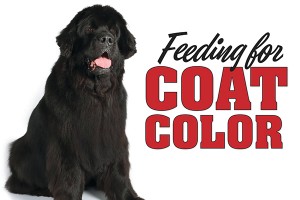
Feeding For Coat Color
Click here to read the complete article
114 – The Annual, 2025-26
 By Caroline Coile
Why are some dogs the blackest of blacks and whitest of whites in the ring? Genetics, for starters. Hair dye, perhaps. Exposure to the sun, sometimes. But what about nutrition?
Your dog’s coat color is determined by melanin, of which there are two main forms: eumelanin, responsible for black or brown hues, and pheomelanin, responsible for red or yellow hues. All fur colors are determined by the amounts of these two pigments.
Both eumelanin and pheomelanin come from the amino acid tyrosine. Tyrosine can be produced in the dog’s body from another amino acid called phenylalanine, or tyrosine, can be absorbed directly from food–particularly foods high in protein.
If your black dog doesn’t get enough tyrosine or phenylalanine in its diet, his coat will take on a red tinge. Around 10 years ago, a couple of studies showed that black Lab and black Newfoundland puppies fed diets with what was considered adequate levels of tyrosine ended up with redder coats than those fed levels considered overabundant; a later study showed the same to be true with adult black Labs. Those dogs fed the standard levels had less black coats compared to those fed levels considered high. It took about 24 weeks for the difference to be noticeable.
Unfortunately, dog food labels don’t include levels of tyrosine or its predecessor phenylalanine, and the current AFCO dry matter standards are too low.
Click here to read the complete article
114 – The Annual, 2025-26
Short URL: http://caninechronicle.com/?p=346841
 Posted by AnthonyA
on Dec 27 2025. Filed under Current Articles, Featured.
You can follow any responses to this entry through the RSS 2.0.
Both comments and pings are currently closed.
Posted by AnthonyA
on Dec 27 2025. Filed under Current Articles, Featured.
You can follow any responses to this entry through the RSS 2.0.
Both comments and pings are currently closed.
Comments are closed